
|
|
|
|
Ari Gold: A Gay New Yorker in the Pop Music World
|
|
Ari Gold granted us an interview in which he talked about his music, growing up Jewish (something he uses in the beautiful ballad Bashert) and also his thoughts about the gay marriage question: Ernest Barteldes: Although your sound is very hip-hop influenced, you have a so much in your sound that I can't put my finger on. What did you grow up listening to, and what has influenced you as a musician? Ari Gold: I'm influenced by all music...I got a lot of influence from white male soul singers like Michael McDonald, George Michael and Hall and Oats. Of course all the female R&B singers as Chakah (Khan), Whitney (Houston), Mariah (Carey), Mary J. (Blige), Brandy...I love some house music too. And Stevie Wonder is the king. Sade, Michael Jackson, Janet (Jackson)...of course Madonna. I was big into R&B in the late 80s with all the Jimmy Jam and Terry Lewis and LA Reid and Babyface produced stuff.....I could go on and on... Ernest Barteldes: How do you feel as an artist in what is believed to be a homophobic medium? Ari Gold: Even though hip-hop and R&B are kissing cousins these days and even though there are some rappers who may be homophobic, I don't consider the genre itself to be homophobic. I think there is a real absence of gay-themed material out there in all of pop music. But music is not homophobic. The industry might be and certain artists might be, but I think anyone who can relate to a love song can relate to any of my songs no matter if I'm singing to a man or whoever. And I am singing to people who understand that. Ernest Barteldes: In a first hearing, your lyrics sound very personal. How much of your own life do you allow to have in your songs?
It's stuff like that that makes me realize how important it is to be honest. But what is cool is when you write from such a personal place and then see how so many people can relate to what you are going through. Or, at least, the songs evoke something that is meaningful to them and that's a very rewarding part of what I do. Like the title track of my CD, Space Under Sun, I wrote that from a completely personal place, but when I listen to it back in the context of the rest of the album, I realize that it can speak to what we all go through especially as gay people, trying to figure out how we fit into this world and who we all are as individuals and as a collective. Ernest Barteldes: I noticed from the CD's credits that you have worked with producer Desmond Child (note: Child has worked with numerous A-list artists such as Kiss, Mariah Carey, Whitney Houston and others). How was that experience? Ari Gold: I learned a lot from that experience. Desmond is very talented and knows what he wants. He's a hard worker and a perfectionist. We didn't exactly see eye to eye about what kind of image I should have. He wanted me to be a mainstream star and I, of course, had no problem with that, but I did have issues with how he wanted to go about making that happen and I think ultimately the compromises he wanted me to make were too much for me and so we went our separate ways. Ernest Barteldes: When you perform, who do you want to take your message to as an artist? Ari Gold: I have to say that the first people that I want to hear my message are gay people, because I think it is important for us to see ourselves reflected back in a real and honest way. Not just to look toward our "Divas" for our identification, (although) there's nothing wrong with that. I even have a song on my album called Fan-tastic which is sort of an ode to divas--in particular, Madonna. But I think gay men need to also have gay men as role models. And as long as I am allowed to be human, I accept that responsibility. I wanted to make the kind of music that I didn't have growing up. But ultimately I think my music is universal and everybody can relate to what I'm singing about...If white kids in middle America can relate to urban hip-hop, I think straight people can relate to the gay experience too, and probably learn a few things as well! Ernest Barteldes: How was your coming out after being raised in an Orthodox Jewish atmosphere, and how much has your background influenced your style? Ari Gold: Well, I call my look shtetle fabulous ( shtetle is the Yiddish term for ghetto). Growing up orthodox definitely influenced me. It both gave me a rebelliousness cause I had to rebel against it in order to accept myself, but it also gave me a side that really appreciates tradition and family. Being Jewish is a big part of my soul and I know it comes out in my music. I mean we have a long history and even the way we pray sometimes sounds like contemporary R&B music! I wrote a song called Bashert, which in Yiddish means "Meant To Be", and that is a concept that Judaism taught me that I still hold very true. For me it is about celebrating all the parts of me and not needing to trade one identity in for another Ernest Barteldes: How do you feel about the current debate about gay marriages? Do you feel (as I do) that we are experiencing a new dimension of the Civil Rights movements of the 60s? Ari Gold: We should definitely have the right to get married in Vegas and then get it quickly annulled the next day. I think gay people deserve to at least have the same rights as Britney Spears! Ernest Barteldes: What's next for Ari Gold. I mean, are you touring, recording...?
Ernest Barteldes: On a playful note: how good is your gaydar? I mean, He's On My Team (note: a song in which he argues in a duet with Kendra Ros whether a man in the club is straight or not) leaves so much to doubt! Ari Gold: Well, as far as that song goes, I'm right! Well, Kendra might disagree...well, when I'm sure of it I'm usually right...but there are definitely times when I am very surprised to hear that someone is either gay or straight! Hey, you know ultimately sexuality is a very individually-based thing and we are all different. I think its cool to hear how we all tick. |
|
 Ari Gold is an openly-gay R&B artist
 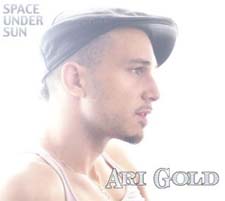 Ari Gold: They are very personal! I always write from my life and my experiences. There was this big producer who told me I had to write from my own life and then when I would write stuff that was explicitly gay themed, he'd be like, "What are you doing? That's never gonna be played on the radio!"
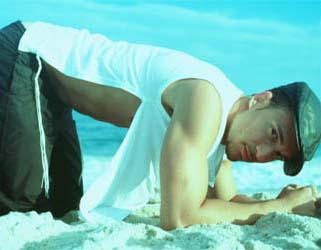 Ari Gold: I've been touring a lot in the states and come June I'll be performing at Pride Festivals around the world. Sometimes I do club dates with my dancers and other times I get to perform with my band. Of course performing with a live band is the best. I've also been recording some duets with Boy George for mine or his next album, which is very exciting because I covered his classic song Do You Really Want To Hurt Me on my new album.