
|
|
|
|
Speaking for Our Lives (1892-2000) The Book Nook |
|
Speaking for Our Lives: Historic Speeches and Rhetoric for Gay and Lesbian Rights (1892-2000), edited by Robert B. Ridinger; Harrington Park Press; 905 pages; $49.95 paper bound; $69.95 hardbound. 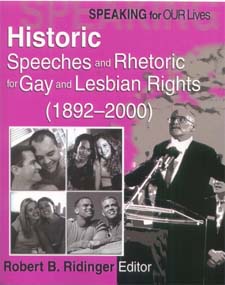 This valuable resource is a collection of classic speeches and rhetoric that defined the gay, lesbian, bisexual and transgendered (GLBT) movement. According to editor Robert B. Ridinger, it "is intended to serve as both a beginning compilation of this elusive genre of gay and lesbian historical sources and as a wake-up call to those same historians and activists to consider the preservation of this most public aspect of their verbal contributions to the struggle for gay and lesbian civil rights."
Speaking for Our Lives goes beyond formal speeches to include "letters, poetry, manifestos, testimony at public hearings, proclamations by city officials, and remarks at venues ranging from gay and lesbian pride parades to the floor of U.S. Congress and the marches on Washington."
This valuable resource is a collection of classic speeches and rhetoric that defined the gay, lesbian, bisexual and transgendered (GLBT) movement. According to editor Robert B. Ridinger, it "is intended to serve as both a beginning compilation of this elusive genre of gay and lesbian historical sources and as a wake-up call to those same historians and activists to consider the preservation of this most public aspect of their verbal contributions to the struggle for gay and lesbian civil rights."
Speaking for Our Lives goes beyond formal speeches to include "letters, poetry, manifestos, testimony at public hearings, proclamations by city officials, and remarks at venues ranging from gay and lesbian pride parades to the floor of U.S. Congress and the marches on Washington."
Speaking for Our Lives opens with an eulogy delivered by Robert G. Ingersoll at the funeral of "the Good Gay Poet," Walt Whitman, on March 30, 1892. It includes classic oratory by Del Martin, Hal Call, Franklin Kameny, Jack Nichols, Arthur Bell, Frieda Smith, Jim Foster, Bruce Voeller, Robin Morgan, Barbara Grier, Tommy Avicolli, Eric Rofes and other activists. The editor did a good job at including the various GLBT communities in all of their diversity, though there are some notable absences. (Harvey Milk is the most obvious one.) Perhaps the most poignant item included in this book is "Song to My Master," a performance piece by "Golden Bear" John Eric Larsen (1965-2001). This "two-volume cycle of lyric poetry (accompanied by original music)" was composed by Larsen in 1990 and "performed by him at many venues within the leather community of the Midwest, including the Metropolitan Community Church service held during the International Mr. Leather contest in Chicago in 1968." Larsen died on April 2, 2001, another example of a brilliant generation of talented gay men that was lost to AIDS. Fabulous!: A Loving, Luscious, and Lighthearted Look at Film from the Gay Perspective by Donald F. Reuter; Broadway Books; 192 pages; $16.95.
In Fabulous!, Reuter explains the "reel connection" between gay men and a film industry that for a long time denied our existence. Lacking positive gay images on the screen, gay men related to movies with strong female characters ("Do we want to be like this person?") and/or with attractive male characters ("Do we want to be with this person?"). Gay men's empathy with (heterosexual) leading ladies - rather than with (heterosexual) leading men - is a phenomenon that Reuter calls the "Fabulous! Identification Theory." "Because our socio-sexual dynamic in relation to gender is notably reversed," notes Reuter, "the actress becomes [our] role model and the actor becomes [our] sex object.... This is the hardest part for many straight folk, especially men, to swallow. However, it is an honest report of what actually occurs in the minds of nearly all movie going gay males...." This is the reason why gay men are among the biggest fans of "women's pictures;" or why Lifetime is famously known as "television for women and gay men." Reuter puts his theory to the test in the main section of the book, which consists of detailed analyses of over a hundred gay film favorites. They run the gamut from old warhorses like All About Eve and Auntie Mame to new releases like Chicago and Boogie Nights. Each film analysis is illustrated with a still and includes a plot summary, a bit of dialogue, "fun facts" and a list of reason why such a movie appeals to the Friends of Dorothy. (The Wizard of Oz, of course, is included.) On the other hand, strictly "gay films" are left out of Fabulous!, for various reasons. (Reuter does provide a list of favorites.) Those who want a careful analysis of "gays on film" should look elsewhere. The purpose of Fabulous! is for the reader to have a good time, and to compare memories of classic films with Mr. Reuter's bright and campy comments. My Favorite Book: comes to us from P-FLAG Dad Steve Krantz: Blindness by José Saramago [Harvest, 1999] is one of the greatest books written in the last millennium. José Saramago is a Nobel Prize winner with a unique written "voice." Blindness is one of the most powerful and meaningful books I have ever read. I know that you will enjoy it." If you, Dear Reader, have a favorite book you wish to share, e-mail the title and the author; a sentence or two explaining why you like that book so much; and a name that we can use to jessemonteagudo@aol.com. Subject: "Book Nook Favorite Book." Jesse Monteagudo is a freelance writer and gay book lover who lives in South Florida with his accordion-playing husbear. Write him a note at jessemonteagudo@aol.com . |
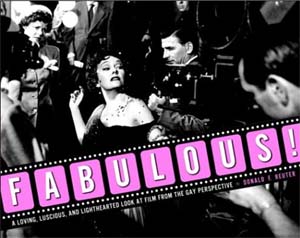 Donald Reuter's second book (after last year's Gaydar) is "a celebratory film book which is based on the notion that there may be a special link between movies and gay people (specifically gay males)....The main intention of the book is to show that when it comes to interests and habits, the gay community - because of its historic invisibility - may constitute the most intriguing market catered to by the business." It is not too much of a stretch to say that gay men love movies the way some straight men love sports. (The Oscars® are fondly known as the "gay Super Bowl.") Yet, until recently, the subject of male love was barred from the silver screen.